
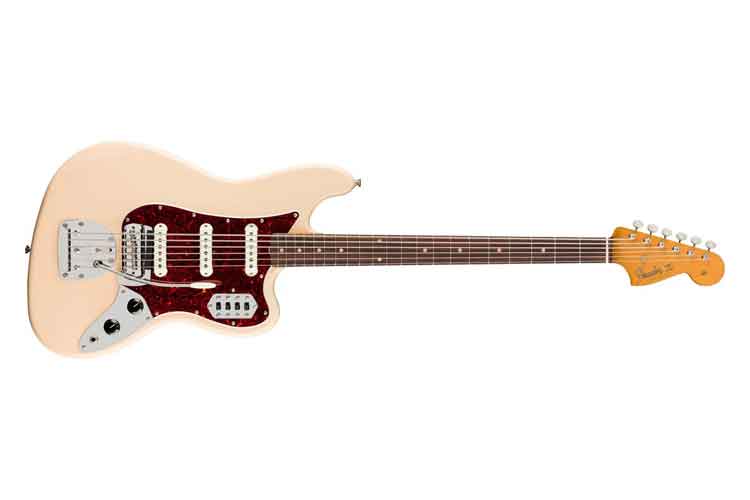
The Fender Vintera III Early ’60s Bass VI sits in that strange, addictive space between a guitar and a bass, and it doesn’t apologize for it. From the second you pick it up, you realize this isn’t just another offset with vintage appointments—it’s a whole different mindset. Fender leaned hard into the early ’60s blueprint here, and the result is an instrument that feels like it came straight out of a time when experimentation was the rule, not the exception. There’s something about the way it hangs on a strap, the way the body resonates against you, that immediately pushes you into writing differently. You don’t just play it, you start exploring it.
The alder body brings that familiar Fender backbone, giving you a tone that’s balanced but never sterile. There’s a natural punch in the low end, but it doesn’t get flubby, and the highs have that glassy shimmer without ever turning harsh. It’s the kind of resonance you feel before you even plug in, and once you do, it translates into a sound that has both clarity and weight. It’s not trying to overpower a mix like a traditional bass, and it’s not sitting on top like a standard guitar either. It finds this perfect in-between pocket that makes it incredibly usable in layered arrangements.
The neck is where things start to get interesting in a very real, hands-on way. That early ’60s “C” shape feels immediately familiar, but the 30-inch scale changes the game just enough to keep you on your toes. If you’re coming from guitar, there’s a slight stretch that forces you to be more intentional, and if you’re coming from bass, it feels fast and almost nimble. The 7.25-inch radius and round-laminated rosewood fingerboard bring that unmistakable vintage curvature, which makes chord work feel natural and expressive, especially when you’re digging into those jangly, chorus-soaked voicings. The vintage tall frets help bridge the gap between old-school feel and modern playability, giving you enough height to really grab the string without fighting the board.
Once you start dialing in the electronics, the personality of this instrument really opens up. The three vintage-style early ’60s single-coils are wired with individual on/off switches, and that alone turns the Bass VI into a tonal playground. You’re constantly flipping combinations in and out, chasing different textures, and it never feels redundant. The bridge pickup can get tight and cutting, almost like a baritone guitar that’s ready to slice through a dense mix, while the neck pickup leans into a deeper, rounder voice that can sit underneath everything with authority. When you bring all three pickups into play, there’s this huge, piano-like quality where the low end blooms and the highs shimmer just enough to keep everything defined. Engaging the strangle switch tightens the low end and shifts the entire voice into something more percussive and articulate, which is perfect when you want clarity without losing character.
The tone itself is where this instrument really earns its keep. There’s a richness to it that feels alive, almost like each note has a little extra dimension to it. You hit a low note and it doesn’t just sit there, it expands and breathes. There’s a harmonic complexity that makes even simple lines sound more interesting, and when you start adding effects, it becomes something else entirely. Reverb and tremolo turn it into a cinematic machine, the kind of sound that feels like it belongs in a wide, open landscape or a dimly lit club scene. Push it with some overdrive or fuzz and it holds together in a way that a lot of instruments in this range don’t, keeping articulation while still getting gritty and aggressive.
The floating tremolo is one of those features that really defines the experience. It’s not built for abuse, it’s built for expression. There’s a smooth, subtle movement to it that lets you add just enough wobble to chords or single-note lines to create motion without pulling things out of tune. It pairs beautifully with the natural sustain of the instrument, letting notes drift and sway in a way that feels almost vocal. The tremolo lock is a practical touch that keeps things stable when you need it, and it’s the kind of detail that shows Fender was thinking about how players actually use these guitars in real situations.
Even the old-school Bass VI mute adds a layer of personality. It’s a bit of a throwback, but when you engage it, you get that thumpy, controlled attack that can sit perfectly in certain mixes. It’s not something you’ll use all the time, but when you need it, it’s there, and it does exactly what it’s supposed to do. The vintage-style tuning machines round everything out with solid stability, and while they don’t scream modern precision, they hold their own and fit the overall vibe of the instrument perfectly.
Spending time with this Bass VI changes how you approach playing. You start thinking less about traditional roles and more about texture and space. It pushes you to write parts that aren’t just rhythm or lead, but something in between, something that connects everything else together. It’s the kind of instrument that makes you slow down just enough to be intentional, but not so much that it feels restrictive. There’s a flow to it once you settle in, and that’s where it really shines.
What stands out most is how inspiring it is. It doesn’t feel like something you’ve played a hundred times before. It nudges you into new territory without forcing it, and that’s a rare thing. You might pick it up planning to track a simple line and end up building an entire arrangement around it instead. That kind of creative pull is hard to fake, and it’s where this instrument separates itself from more conventional designs.
The Fender Vintera III Early ’60s Bass VI feels like a faithful nod to its roots, but it doesn’t come off as a museum piece. It’s alive, it’s usable, and it’s full of character. It’s not trying to be the most versatile instrument on paper, but in practice, it covers more ground than you’d expect because of how it sits in a mix and how it responds to your hands. There’s a certain swagger to it, a bit of attitude that comes from its quirks, and instead of smoothing those edges out, Fender let them shine.
If you’re looking for something that breaks you out of the usual patterns, something that makes you rethink how you approach tone and arrangement, this is the kind of instrument that delivers in a big way. It’s not about replacing your main guitar or bass, it’s about adding a new voice that brings something unique to the table. Once you get comfortable with it, it becomes less of a novelty and more of a go-to for ideas you can’t quite get anywhere else, and that’s where it really proves its worth.


