
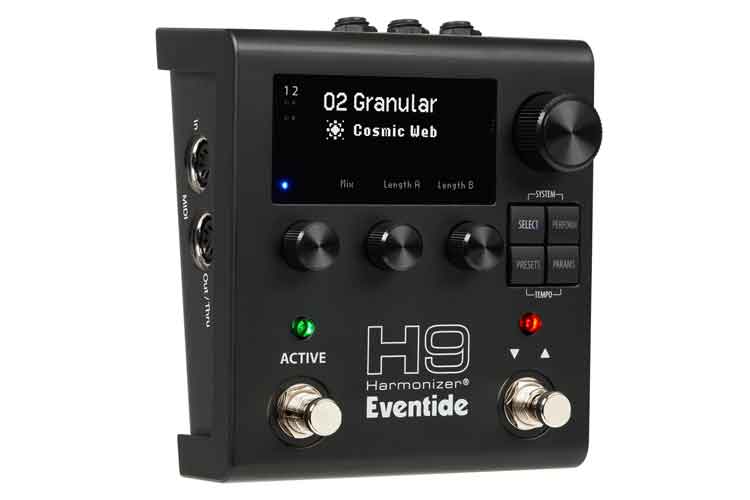
I should probably begin by making one thing clear: I do not own the Eventide H9 Gen 2 yet, so this is not one of those reviews where I am going to pretend I have spent six months touring with it, opened it up on a workbench, measured every converter and run it through twenty different amplifiers. What I have done is spend a considerable amount of time studying it, reading through Eventide’s documentation, looking closely at the signal specifications, working through the algorithm list and comparing the operating structure with the original H9 that I already know extremely well. I am coming at this as a guitarist who is seriously considering making the move from the original H9 to the Gen 2, and that is not a decision I take lightly because I genuinely love my first-generation H9.
My original H9 has not simply been another pedal sitting on my board. It has been one of the cornerstones of my recorded guitar sound for the past two albums. It has handled everything from barely noticeable thickening and width to delays, modulation, pitch manipulation and those enormous ambient effects that can make a guitar part feel as though it occupies a much larger physical space than it actually does. There are sounds on those records that I associate as much with the H9 as I do with a particular guitar, amplifier or microphone. That makes the Gen 2 interesting to me, but it also means it has a fairly high bar to clear. I am not looking to replace the original because it suddenly sounds bad. It does not. I am looking at the Gen 2 because Eventide appears to have preserved the underlying concept while modernizing nearly everything around it that could benefit from another decade of processing development and user feedback.
What immediately appeals to me is that Eventide did not turn the H9 into a completely different product. The Gen 2 is still fundamentally a compact, single-algorithm Eventide processor. It is not an amp modeler, a recording interface, a giant floor controller or a replacement for the H90. It is still built around the idea that one extremely deep Eventide algorithm can often accomplish more than several ordinary effects chained together. That distinction matters. A single Eventide algorithm is not necessarily equivalent to one conventional stompbox effect. Something such as SpaceTime, ModEchoVerb, PitchFuzz or Blackhole can contain several interacting stages of processing, modulation, filtering, feedback and dynamic behavior. Describing the H9 as capable of running only one effect at a time has always been technically true, but it can also be misleading if someone interprets that as meaning it produces only one simple sound at a time.
The Gen 2 contains 74 algorithms, incorporating the full H9 Max and H90 algorithm collections, and Eventide says it ships with more than 1,000 presets. It also remains compatible with presets created for the earlier H9 models, which may be one of the most important details for existing owners. I have years invested in understanding how the original H9 reacts, how its parameters interact and which sounds work in an actual recording rather than merely sounding impressive in isolation. The ability to carry those presets forward means this is not necessarily a complete reset. It should be possible to preserve the sounds that already work and then build outward from them using the additional processing options and more capable control structure.
The expanded algorithm library is obviously a major attraction, but I find the nature of the expansion more interesting than the raw number. Eventide has moved beyond the traditional categories of delay, modulation, reverb and monophonic pitch shifting. The Gen 2 includes granular algorithms such as Cosmic Web, Glitch, GrainMod and Stutter; newer polyphonic pitch tools such as PolyFlex, Polyphony and Prism Shift; synth-oriented processing such as PolySynth, HotSawz and Synthonizer; and a much broader range of distortion, filtering, utility and vocal-processing algorithms. The traditional Eventide material remains present as well, including MicroPitch, H910/H949-style shifting, Quadravox, Diatonic, Crystals, Blackhole, SP2016 Reverb, UltraTap, Tape Echo, Vintage Delay, TriceraChorus, Instant Flanger and Instant Phaser. The library covers a remarkable amount of sonic territory without abandoning the sounds that established Eventide’s reputation in the first place.
For a studio guitarist, that matters because the H9 has always been useful for far more than creating an obvious “effect.” Some of my favorite applications are the ones where a listener would never identify the processor. MicroPitch can widen a doubled rhythm part without turning it into an obvious chorus. A carefully filtered delay can add motion without stepping on a vocal. A short, dark reverb can move a close-miked amplifier backward in the image without making the guitar sound washed out. A small amount of detuning can make a mono guitar feel larger while still leaving space in the center for the bass, kick and vocal. The expanded Gen 2 library appears to provide even more ways to work at that level, particularly through the newer spectral, granular and polyphonic algorithms.
Eventide specifically identifies SIFT, or Spectral Instantaneous Frequency Tracking, as the technology behind the Gen 2’s high-fidelity polyphonic pitch effects. Polyphonic pitch shifting is one of those areas where the quality of the processing becomes obvious very quickly. A basic monophonic shifter can behave well enough on a single-note line but fall apart when it receives a chord, a sustained interval or a note with complicated harmonic content. The processor has to identify and reconstruct a moving collection of partials without turning the attack into a smear or creating the metallic, phasey artifacts that immediately announce digital pitch processing. The newer SIFT-based algorithms are designed for more complex material, which opens the door to using pitch transformation on full chords, layered rhythms and textural guitar parts rather than reserving it for isolated lead lines.
I would still approach any manufacturer’s claims about pitch shifting with a guitarist’s usual skepticism because the real test is not a specification sheet. The real test is how the unit behaves when the pick attack is hard, the chord contains close intervals, the guitar is slightly out of tune, the amplifier is already compressing and the signal contains noise from high-gain pickups. Eventide has more experience with this type of processing than nearly anyone, however, and the H90-derived architecture gives the Gen 2 considerable credibility before I have even plugged into one. Based on the design and available algorithms, I expect the pitch processing to be one of the areas where the change from the original H9 will feel like more than a cosmetic update.
The internal digital architecture is also reassuringly serious. The Gen 2 operates at a fixed 48 kHz sample rate, uses 24-bit analog-to-digital and digital-to-analog conversion, and performs its internal DSP calculations using 32-bit floating-point processing. None of those numbers alone guarantees that a processor will sound good, but together they describe a sensible architecture for a dedicated real-time effects unit. Twenty-four-bit conversion provides ample theoretical dynamic range for guitar and line-level recording applications, while floating-point internal processing gives the algorithms considerable headroom when multiple internal stages of gain, filtering, modulation, feedback and summing are involved. That becomes especially important in long feedback structures, pitch-shifted reverbs and algorithms where the signal may circulate repeatedly through the processor.
The 48 kHz sample rate is worth discussing because people sometimes assume that a larger number automatically equals better sound. For a device like this, the practical issue is not simply the sample rate but the quality of the filters, converter implementation, clocking, analog stages and algorithms surrounding it. Forty-eight kilohertz provides an audio bandwidth beyond the range of human hearing while leaving enough processing capacity for complicated real-time algorithms. Eventide is balancing bandwidth, latency, DSP load and stability rather than chasing a number for the front of the box. I record at home using both 44.1 and 48 kHz sessions depending on the project, and the fact that the H9 itself operates internally at 48 kHz would not concern me. When used as an analog hardware insert, the audio interface and H9 converters define their respective sides of the signal path independently.
The new ARM-based processing platform is probably the most significant technical change beneath the surface. Eventide describes the Gen 2 as using modern processing derived from the H90 platform. The H90 is capable of running two algorithms, while the H9 Gen 2 remains a single-algorithm design. That should not be interpreted as the Gen 2 being an H90 with half of the jacks removed, but it does indicate that the new H9 is operating on a substantially more modern foundation than the original unit. The increased processing capacity is what makes the expanded H90 algorithm library, improved workflow and newer pitch-processing methods practical in the smaller H9 format.
I am particularly interested in what that newer architecture may do for the less obvious parts of the experience. Processing power is not only about creating a more spectacular reverb. It can affect preset loading, parameter smoothing, pitch detection, modulation resolution and the ability to preserve natural trails when changing sounds. Eventide specifies seamless effects spillover between presets, which is essential for recorded and live guitar parts built around long delays or reverbs. Nothing destroys the illusion of space faster than a reverb tail being chopped off because the next section requires a different preset. The Gen 2 is designed to allow the previous effect to decay naturally as the next preset takes over, preserving continuity rather than announcing the mechanics of the preset change.
Eventide does not publish one universal latency figure for the entire pedal, and that makes sense because latency can depend heavily on the selected algorithm. A conventional modulation effect does not present the same computational problem as polyphonic pitch detection or vocal tuning. I would be suspicious of any review that claimed every algorithm had exactly the same latency or that the latency was literally zero. Digital conversion, buffering and processing always consume some amount of time. The more useful question is whether the delay is perceptible or disruptive in its intended application. The original H9 has never caused me a practical timing problem during recording, and the Gen 2’s newer processing architecture gives me no reason to expect a step backward. I would still evaluate the most complex polyphonic and Harmonizer+ algorithms carefully before printing them onto a performance, but that is simply good studio practice with any pitch-processing hardware.
The analog input and output design is one of the areas where the Gen 2 looks especially useful for a home studio. It provides two quarter-inch mono inputs and two quarter-inch mono outputs, and the operating levels can be configured for either instrument or line-level use. In instrument mode, Eventide specifies an input impedance greater than 600 kilohms and a maximum level of +4 dBu. In line mode, the input impedance is 80 kilohms and the maximum level increases to +14 dBu. The output impedance is listed at 220 ohms, with a recommended load of 10 kilohms. Those are meaningful specifications rather than marketing decoration. The higher instrument-level impedance helps avoid excessively loading passive guitar pickups, while the +14 dBu line-level capacity provides considerably more room when integrating the unit with an audio interface, mixer, preamp or professional send-and-return path.
For me, the ability to configure instrument and line levels is critical because I do not think of the H9 only as a pedalboard effect. The original has been part of my recording chain, and I want the option of using the Gen 2 after pedals, in an amplifier’s effects loop or as an external processor connected to an audio interface. At home, I could record a clean or lightly processed guitar track, route that track out through a spare line output, process it through the H9 and record the stereo return on two new tracks. That preserves the original performance and allows the effect to be committed later, when the arrangement is clearer. It also makes it possible to use the H9 on synthesizers, drum machines, vocals or nearly anything else that can be routed through a line-level send.
This is one reason hardware effects remain worthwhile even in a studio filled with excellent plug-ins. A plug-in is convenient, repeatable and usually automation-friendly, but an external processor changes the way I make decisions. Sending a track through a physical box encourages me to listen, manipulate the sound and commit to something. It can turn reprocessing into a performance rather than a menu operation. An expression pedal can move several parameters at once. A HotKnob can transform a sound through a predefined range. A HotSwitch can jump between parameter states. Those gestures can be recorded into the return just like a guitar performance, producing movement that would be tedious to draw with a mouse.
The routing options are another reason I see the Gen 2 as studio equipment rather than merely a floor pedal. Eventide provides Wet/Dry and Pre/Post configurations, continuing the flexibility of the original H9. Wet/Dry operation can be valuable when the processed signal needs to be separated from the unprocessed path for external blending or recording. Pre/Post routing is useful in a four-cable amplifier setup, where the same processor can be integrated around different sections of the amplifier’s signal path. This allows effects that normally belong before the preamp, such as certain pitch or modulation treatments, to coexist with delays and reverbs that are generally more controlled in the effects loop.
In a home studio, Wet/Dry routing can also support more deliberate mixing. I generally prefer recording the dry or core guitar tone separately from large ambience whenever possible. Once a huge stereo reverb has been printed directly into a mono guitar track, the relationship between the guitar and the room becomes difficult to change. Keeping a dry signal and a dedicated wet return allows the reverb to be filtered, compressed, widened, automated or muted independently. The H9’s ability to operate at line level and provide a stereo return makes it suited to exactly that type of workflow.
The front-panel redesign may end up being the biggest everyday improvement for original H9 owners. I have never considered the first H9 impossible to use, and I actually like the clean simplicity of its physical design, but deep programming has generally been easier through the H9 Control application than from the pedal itself. The Gen 2 adds a larger 2.5-inch display, three Quick Knobs, contextual button pads and direct access to the complete parameter set without requiring an app. The Big Knob remains part of the interface, but it now operates within a more structured system of Select, Bank, Perform, Preset and Parameter modes.
That may sound like a usability detail rather than a sonic one, but in the studio the two are connected. A processor that is easier to edit is a processor that gets edited more precisely. When a delay is almost right but needs slightly less modulation and a darker feedback path, I do not want the interface to interrupt the creative thought. When the decay of a reverb is masking the next chord, I want to reach down, identify the relevant parameter and make the correction immediately. The three Quick Knobs provide direct access to selected parameters in both of the principal play modes, while the full Parameter Edit mode allows deeper adjustment and mapping. That should make the Gen 2 feel much more like an instrument and less like a hardware endpoint for a software editor.
I am glad that Eventide has not abandoned software control, however. USB-C connects the Gen 2 to the Eventide Control application for firmware updates and preset management, and it can also receive MIDI over USB. Bluetooth control is available for supported Mac and iPad use, while traditional five-pin MIDI input and output/thru connections remain available for hardware rigs. That combination is exactly what I would want. USB-C handles modern computer integration without requiring an old cable, while five-pin DIN MIDI means the unit can still communicate directly with established foot controllers, keyboards, sequencers and rack equipment.
The MIDI implementation appears extensive enough for serious studio and performance use. The MIDI input can select programs with Program Change messages, control parameters and synchronize the H9 to an external MIDI clock. The output can transmit Program Change and controller information and can pass or generate synchronization information. For a home recording setup, that means preset changes and tempo synchronization can be driven from a DAW session. A song could call up the correct H9 program at the beginning of a section and keep tempo-based delays tied to the project clock. In a more traditional guitar rig, a MIDI controller could change the amplifier channel, switch other pedals and load the corresponding H9 preset with one command.
The expression and control connections also appear well thought out. The expression input accepts common 10–25 kilohm expression pedals as well as 0–5-volt control signals. A separate TRS control input supports up to three normally open momentary auxiliary switches. This means the two onboard footswitches do not define the full control ceiling of the pedal. Depending on the application, an external switch can handle tap tempo, preset navigation or another performance function while the expression pedal morphs several parameters.
The concept of HotKnob and HotSwitch control is especially attractive for recording. Rather than assigning an expression pedal to only one static parameter, a macro can move several aspects of an algorithm together. A single sweep could increase the reverb mix, lengthen the decay, raise a pitch-shifted voice and alter feedback at the same time. That creates a controlled transition between two complete versions of a sound. On a sustained chord, the effect could begin as a conventional ambience and gradually open into something enormous and unstable. That type of movement is one of the reasons Eventide effects often feel more like compositional tools than accessories.
The Gen 2’s Perform Mode seems designed around this idea. The two footswitches can be assigned to performance-oriented controls rather than being restricted to basic bypass and preset selection. Select Mode handles browsing and loading presets, Bank Mode arranges presets in groups that can be reached from the switches, and Perform Mode allows customized mappings for active manipulation. That separation should make the pedal easier to understand because preset navigation and sound performance are treated as related but distinct jobs.
I also appreciate that Eventide has included input-level indicators with separate signal-presence and clipping behavior. Gain staging is one of the least glamorous parts of recording, but it is also one of the most important. A sophisticated reverb or pitch algorithm cannot recover detail that has already been flattened by an overloaded input stage. At the other extreme, feeding the processor an unnecessarily weak signal can compromise the effective signal-to-noise ratio. The Gen 2’s front-panel indicators should make it easier to configure the source level correctly whether it is receiving a guitar, a pedalboard, an amplifier-loop send or an interface output.
The line-level maximum of +14 dBu is respectable for a compact processor, although I would still pay attention to how it is connected to professional studio hardware capable of producing very hot levels. My interface outputs can be calibrated differently depending on the application, and there is no reason to hit the H9 harder than necessary. I would begin with the interface output turned down, monitor the H9’s input indicators and raise the send until the signal is healthy without clipping. On the return, I would record with enough headroom for resonant peaks, pitch feedback and long reverb tails. Some of these algorithms can produce substantially more energy than the dry guitar signal, particularly when feedback or regeneration is involved.
The bypass structure and spillover behavior will also influence how I integrate it. For a live board, a true or relay-style bypass can be desirable when I want the device completely removed from the path. In a studio send-and-return configuration, however, I would normally use the unit fully wet and manage the effect from the console, interface mixer or DAW. In that situation, the dry guitar remains untouched on its original track and the H9 becomes a dedicated stereo effects return. This is usually the cleanest way to audition different reverbs and delays without repeatedly passing the dry guitar through conversion stages.
One thing the Gen 2 does not attempt to do is carry audio over USB. Its USB-C connection is for updates, preset management and MIDI rather than operation as a USB audio interface. I do not view that as a serious omission because I would rather use the analog I/O through the converters and routing I have already chosen for my studio. It also keeps the H9 focused on being an effects processor instead of adding another audio driver, monitoring mixer and clocking system to the computer. The tradeoff is that hardware reprocessing requires available interface inputs and outputs, but anyone planning to use outboard processors has to solve that routing problem anyway.
The physical power requirements deserve attention because the Gen 2 does not use the most common center-negative nine-volt pedal arrangement. Eventide supplies a center-positive power adapter, and the manual specifies approximately 300 mA at 12 volts or 400 mA at nine volts. Anyone planning to use a pedalboard supply needs to verify voltage, current capacity, plug dimensions and polarity rather than assuming that an ordinary pedal output will work. This is not unusual for a processor of this type, but it is exactly the sort of detail that can create an unpleasant surprise when rebuilding a board.
Physically, the Gen 2 remains compact at roughly 5.25 by 5 by 2.7 inches and weighs about 1.33 pounds. That is small enough to fit on a pedalboard but substantial enough that it should not feel like a lightweight desktop accessory. I like that Eventide retained the broad, almost square H9 shape rather than making the unit dramatically larger to accommodate the display and additional controls. Part of the original H9’s appeal has always been the amount of processing it fits into a relatively small footprint.
The obvious question for me is why I would choose the H9 Gen 2 instead of moving directly to an H90. The H90 can run two algorithms simultaneously, which opens up combinations the H9 cannot reproduce internally. That is a real advantage, particularly for someone who wants a completely self-contained rig with pitch, modulation, delay and reverb assembled inside one processor. I do not think the Gen 2 should be described as a less expensive H90 without acknowledging that difference.
At the same time, I already have a developed recording chain, amplifiers, pedals and plug-ins. I do not necessarily need the Eventide unit to provide every effect at once. There is something appealing about choosing one deep, high-quality algorithm for a specific job and allowing the rest of the rig to do what it already does well. The single-algorithm structure may also make the H9 easier to operate quickly. There are fewer routing decisions, fewer internal gain relationships and fewer layers to troubleshoot when a preset is not sitting correctly in a mix.
The Gen 2 therefore feels less like a compromised H90 and more like the logical continuation of the H9 philosophy. It provides the modern processing architecture and full algorithm range while preserving the focus and compactness that made the original useful. For a guitarist building an all-in-one performance system, the H90 may be the more obvious choice. For someone like me, who already views the H9 as a specialized studio processor and creative guitar tool, the Gen 2 may represent the more natural upgrade.
I am also not convinced that I would immediately remove the original H9 from service. Because the Gen 2 supports the earlier presets, there may be an opportunity to transfer the essential sounds to the new unit while keeping the original available as a second processor. Two H9s would allow algorithms to be placed in series or parallel, creating combinations that one H9 cannot produce alone. The original could handle MicroPitch or modulation while the Gen 2 provides one of the newer granular, polyphonic or reverb algorithms. In a studio, the two could also serve separate hardware sends. Moving on from the first generation does not necessarily mean discarding it, especially when it has already proven itself across two albums.
The tonal question is ultimately the one I cannot answer conclusively until I hear the Gen 2 in my own chain. Converter specifications and processor architecture can tell me a great deal, but they cannot tell me exactly how a familiar preset will feel under the fingers. The original H9 has a response I know. I understand how it reacts to clean guitar, gain, sustained chords and the upper-midrange content of my amplifiers. Before committing a major sound to a recording, I would want to compare the original and Gen 2 at matched levels, using the same preset where possible, and monitor both the dry attack and the decay of the processed signal.
I would pay particular attention to transient definition, stereo image, noise floor, low-frequency buildup and how the new converters behave with high-gain guitar. I would listen for whether the dry component remains solid and centered, whether modulation stays smooth at slow rates and whether long feedback paths develop harshness as they regenerate. I would also compare the way pitch algorithms treat pick noise, vibrato and chord transitions. Those are more revealing tests than playing a dramatic factory preset for thirty seconds.
Even without that final hands-on comparison, the direction of the Gen 2 makes sense to me. Eventide has retained the strongest parts of the H9 concept, expanded the algorithm library to 74, introduced the H90-derived ARM platform, upgraded the physical interface, added direct parameter editing, modernized the computer connection to USB-C, preserved five-pin MIDI and Bluetooth control, retained instrument and line-level operation, and maintained compatibility with older presets. This does not read like a superficial refresh designed to make existing owners buy the same pedal twice. It appears to address the actual limitations that longtime H9 users have discussed while leaving the essential identity of the unit intact.
That is why I am seriously considering the move. I am not trying to escape the sound of my original H9. I am trying to carry that sound forward. The first generation has earned its place in my studio and has been part of the sonic identity of my last two albums. Any processor capable of replacing it has to offer more than a brighter screen and a longer preset list. The Gen 2 appears to offer a genuinely more powerful processing platform, a broader creative vocabulary and an interface that should make the depth of the algorithms easier to reach while a musical idea is still fresh.
There is also something reassuring about upgrading within a system I already trust. I know what Eventide delays feel like. I know how MicroPitch can make a guitar spread across a mix without sounding like an obvious double. I know how Blackhole can turn a simple sustained note into an entire background arrangement. I know how the original H9 can take an ordinary part and reveal a direction I had not considered when I played it. The Gen 2 does not ask me to abandon that language. It adds new words, improves the controls and gives the processor more room to speak.
At this point, my view of the H9 Gen 2 is extremely positive, but it is positive for specific reasons rather than blind enthusiasm for a new piece of gear. The specifications are appropriate for serious recording, the routing is flexible, the control system appears dramatically improved, the MIDI and expression implementation is deep enough for advanced rigs, and the algorithm library is probably the most comprehensive collection Eventide has placed into a compact single-engine pedal. It also seems unusually well suited to the way many of us actually record now, moving back and forth between amplifiers, pedalboards, audio interfaces, DAWs and home-studio reprocessing.
I am not ready to declare that the Gen 2 makes the original obsolete, and I doubt I ever will. Gear that helped create two albums does not become irrelevant because a newer version arrives. The original H9 has already earned its reputation in my studio. What the Gen 2 appears to offer is a way to preserve everything I value about that unit while removing much of the friction, expanding the available sounds and moving the platform onto a more modern technical foundation.
That makes the upgrade feel less like replacing a trusted piece of equipment and more like opening the next chapter of a working relationship. I already know the H9 can become part of the identity of an album because it has done exactly that for me twice. Based on everything I have learned about the Gen 2, I am genuinely excited to find out what it might contribute to the next one.


