
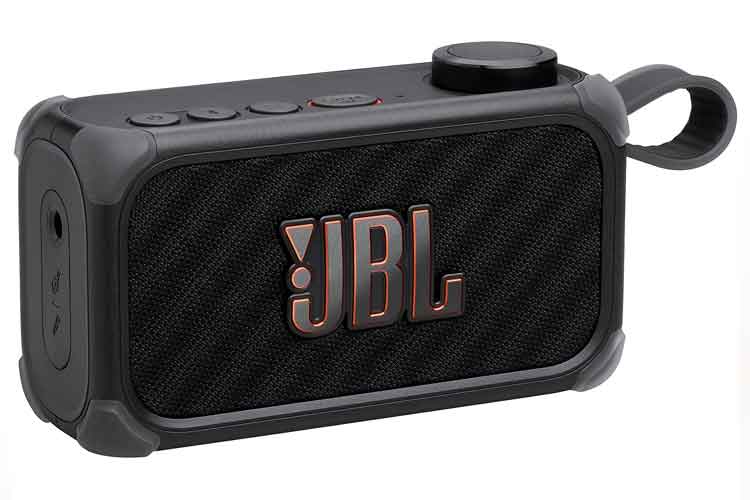
The JBL BandBox Solo is much more than a compact practice amplifier. It is an impressively complete practice, performance, and recording system that combines a guitar amp, vocal monitor, Bluetooth speaker, effects processor, AI-powered music-separation tool, tuner, metronome, looper, and USB audio interface in a package small enough to carry almost anywhere. It is one of those rare products that can genuinely change how often you practice because it removes nearly all the usual setup time. Turn it on, connect your instrument or microphone, stream a song, and you are ready to play.
The feature that immediately separates the BandBox Solo from an ordinary portable amplifier is JBL’s Stem AI technology. Stream a song to the BandBox and it can separate the guitar, vocals, and drums in real time. That opens up an enormous number of practice possibilities. A guitarist can mute the original guitar and take its place in the mix. A singer can remove the lead vocal and front the band. Bassists can concentrate on locking in with the drums, while drummers can isolate rhythmic elements and study the groove more closely. If a particular guitar riff, vocal phrase, or drum part is giving you trouble, you can isolate it and work on it until it becomes second nature.
This is a much more natural and enjoyable way to learn songs than constantly stopping, rewinding, and trying to hear an instrument buried in a full mix. The BandBox Solo turns the music you already love into an interactive backing track. Instead of feeling as though you are practicing alone in a room, you feel like you have stepped into the song and joined the band. The JBL One app provides even more precise stem separation, including dedicated drum separation, and allows you to control the feature from your phone.
The sound quality is exactly what you would expect from JBL. The BandBox Solo uses a 2.25-inch full-range transducer powered by 18 watts RMS, producing a remarkably clean and powerful sound for such a small enclosure. Its frequency response extends from 73 Hz to 20 kHz, with a signal-to-noise ratio greater than 80 dB. Those specifications translate into clear vocals, articulate guitar tones, punchy drums, and enough low-end presence to make streamed music sound full rather than thin or harsh.
For a compact practice amp, the BandBox Solo has an impressive amount of volume. It is easily capable of filling a bedroom, office, backstage area, hotel room, or other personal practice space. More importantly, it remains clear as the volume increases. Guitar effects retain their definition, vocals stay intelligible, and backing tracks do not collapse into a muddy wall of sound. It can get loud enough to make practicing exciting without losing the detail needed to hear what you are actually playing.
The guitar tones are another major strength. BandBox Solo includes both vintage and modern amplifier models, making it possible to move from warm clean sounds and bluesy breakup to classic crunch and aggressive modern tones without connecting a separate amplifier or pedalboard. The built-in effects include staples such as phaser, chorus, tremolo, and reverb, giving you the essential tools needed to shape a wide range of sounds.
The effects are useful for more than simply adding decoration to a basic guitar tone. Chorus can add width and movement to clean passages, tremolo can bring vintage character to rhythm parts, phaser can create swirling classic-rock textures, and reverb can make even a quiet practice session feel more spacious and inspiring. You can quickly dial in a familiar sound or experiment with combinations that lead you somewhere completely unexpected.
The JBL One app expands the tonal possibilities even further. From the app, you can adjust volume, tone, EQ, pitch, presets, amplifier models, and effects-chain settings. You can customize the presets stored on the BandBox Solo, explore additional guitar sounds, and change effects while you are playing. It essentially turns your phone into a detailed editor and remote control for the entire system. Once you create a sound you like, you can save it as a preset instead of rebuilding it every time you practice.
JBL has also done an excellent job with the built-in practice tools. The tuner helps you get ready quickly, while the app provides different tuning modes and a chromatic tuner for alternate tunings and more precise setup. The metronome can be adjusted from 30 to 240 beats per minute and supports selectable time signatures, making it useful for everything from slow technical exercises to fast rhythm work.
The pitch-shifting features are particularly convenient. If the song you want to practice is in an alternate tuning, you can shift the music to match your instrument instead of stopping to retune. Singers can also change the key of a track to place it in a more comfortable vocal range. This makes the BandBox Solo useful not only for learning existing arrangements but also for rehearsing songs in keys better suited to your own voice or instrument.
The built-in 60-second digital looper adds another layer of usefulness. You can record a rhythm part and play a lead over it, build layered guitar textures, practice harmonies, experiment with bass lines, or improvise over your own chord progression. The looper supports overdubbing, pausing, resuming, and clearing the recorded loop. It is straightforward enough to use during a quick practice session while still offering plenty of room for creativity.
Recording is equally convenient because the BandBox Solo includes a built-in USB-C audio interface. Connect it to a compatible computer or device running a digital audio workstation, and you can record directly from the BandBox without purchasing or connecting another interface. It supports two-channel PCM audio at 48 kHz and 24-bit resolution, making it capable of capturing ideas, practice takes, guitar tones, and more polished recordings with excellent clarity. When inspiration strikes, you do not have to dismantle your practice setup and reconnect everything to a separate recording rig.
The BandBox Solo also works well for both guitarists and singers. It provides dedicated guitar and microphone inputs, with a guitar-input sensitivity of 100 mV RMS and microphone-input sensitivity of 20 mV RMS. Its selectable musician modes include Guitarist, Singer, and Singing Guitarist. Choosing a mode automatically adjusts the available inputs and controls to suit the way you are using the unit. That is a thoughtful feature because it keeps the interface uncluttered and makes the BandBox equally useful for instrumental practice, vocal rehearsal, or singing while playing guitar.
The large integrated LED pixel screen is another smart design choice. It clearly displays tools, settings, amp models, and effects when you need them, then fades into the background once you begin playing. Combined with the main control knob, it keeps the physical interface approachable even though the BandBox Solo contains a considerable number of features. You can access the essentials directly from the unit and turn to the JBL One app when you want deeper control.
Bluetooth 5.4 provides a modern, reliable wireless connection for streaming music from a phone, tablet, or other compatible device. The BandBox supports A2DP 1.4 and AVRCP 1.6 profiles, so music playback and control feel like a natural part of the practice experience. There is no need to connect a second speaker or manage a complicated group of devices. Your streamed music, instrument, microphone, effects, and practice tools all come together through one compact system.
For private practice, the headphone output supports both 16-ohm and 32-ohm headphones and delivers up to 1 Vrms. This means you can practice late at night, work in a shared space, or rehearse while traveling without disturbing anyone nearby. The headphone output can also route audio to a mixer or PA system with the appropriate cable or direct box, giving the BandBox Solo a useful path into a larger sound system when more volume is required.
Portability is one of its greatest strengths. The BandBox Solo measures approximately 5.91 inches wide, 3.43 inches high, and 2.17 inches deep, and it weighs only 1.17 pounds. It can easily fit into a guitar case, backpack, desk drawer, or travel bag. Despite its small size, the internal 17 Wh lithium-ion battery provides up to six hours of music playback, depending on volume and content. Charging takes approximately three and a half hours with the speaker turned off, using a power input of up to 5 volts and 3 amps.
That combination of compact size and battery power makes the BandBox Solo useful almost anywhere. It can sit on a desk for daily practice, travel to rehearsals as a personal warm-up amp, go backstage before a performance, or provide a complete practice solution in a hotel room. Because it can also operate as a Bluetooth speaker, it remains useful even when you are not playing an instrument.
What makes the JBL BandBox Solo especially impressive is how well all of these features work together. The Stem AI system helps you understand and interact with recorded music. The amp models and effects help you create the right sound. The tuner, metronome, pitch controls, and looper help you improve your playing. The Bluetooth connection brings in your music, while the USB-C audio interface lets you send your own performance out to a recording system. Every major feature supports the same goal: helping you play more often, learn more efficiently, and enjoy the process.
There are plenty of small practice amps, portable Bluetooth speakers, effects processors, loopers, and music-learning apps available, but the JBL BandBox Solo combines all of those functions in a way that feels cohesive rather than complicated. It can replace an entire pile of practice gear while taking up less space than many individual pedals.
Whether you are a guitarist learning solos, a singer rehearsing with full-band tracks, a bassist working on groove and timing, a drummer studying arrangements, or a songwriter capturing new ideas, the BandBox Solo has something genuinely useful to offer. It sounds much larger than it looks, gives musicians an impressive range of tones and effects, and uses AI in a way that provides an immediate and practical benefit.
The JBL BandBox Solo is an outstanding all-in-one practice companion. Its 18-watt JBL sound, real-time stem separation, amp modeling, effects, tuner, metronome, pitch shifting, 60-second looper, Bluetooth 5.4 connectivity, headphone support, USB-C recording, six-hour battery life, and extremely portable design make it one of the most complete compact music tools available. It does not simply make practice more convenient—it makes you want to pick up your instrument, try new ideas, and keep playing. Highly recommended.


