
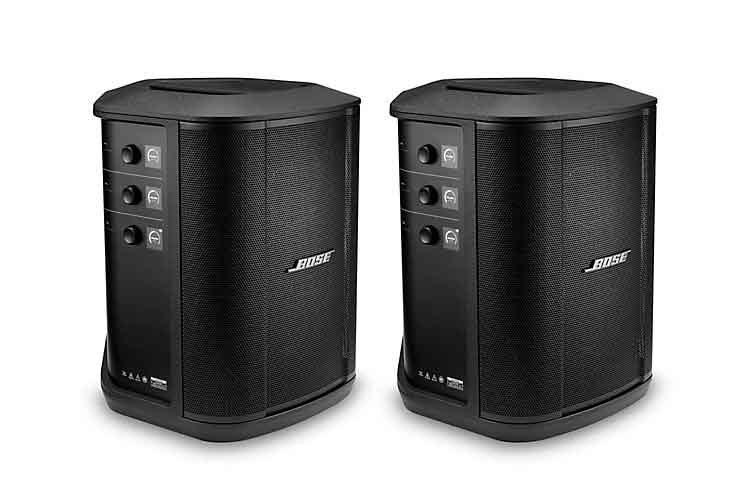
The Bose S1 Pro+ Wireless PA System is one of those pieces of gear that doesn’t really make sense on paper until you actually spend time with it. There are a lot of compact battery-powered PAs out there now, and most of them fall into one of two categories: either they’re convenient but sound thin and underpowered, or they push volume but sacrifice clarity and control. This one tries to thread the needle, and for the most part, it actually does.
The first thing that stands out is how much sound this thing throws for its size. Bose has always leaned into wide dispersion rather than brute force, and you can hear that immediately. Instead of a narrow beam of highs that only sounds good if you’re standing directly in front of it, the S1 Pro+ spreads the sound out in a way that feels much more natural in a room. You can move off to the side, or even behind it slightly, and still get a usable, balanced sound. That matters more than people think, especially in real-world gigs where audiences aren’t neatly arranged in front of you.
The low end is also worth talking about because it’s easy to underestimate it just looking at the cabinet. It’s not hyped or boomy, and it’s definitely not trying to replace a sub, but it’s tight and controlled in a way that actually helps a mix sit better. Acoustic guitars feel full without getting muddy, and vocals don’t get swallowed by low-mid buildup. When you push it harder, the system holds together pretty well. You can tell there’s DSP working behind the scenes keeping things in check, but it doesn’t feel like it’s choking the sound. It’s more like it’s quietly making sure nothing gets out of control.
One of the smarter features here, and something that actually makes a difference, is how the speaker adapts to how you position it. You can set it upright, lay it down, tilt it back like a monitor, or put it on a stand, and it automatically adjusts its EQ. That might sound like marketing fluff, but in practice it keeps the tone consistent in different setups. Anyone who’s ever used a speaker as a floor monitor and suddenly dealt with a bunch of muddy low end will appreciate what’s happening here. You don’t have to fight the room or the placement nearly as much.
The onboard mixer is simple, but in a good way. You’ve got three channels that can handle mics, instruments, and external sources, and everything is right there without digging through menus. The EQ and reverb controls are straightforward, and the reverb itself is actually usable, which isn’t always the case on gear like this. It doesn’t feel like an afterthought. If you’re running a vocal and an acoustic guitar, you can get a clean, polished sound quickly without needing an external mixer. That said, if you’re trying to run a more complex setup, you’ll still want something separate, but that’s not really what this is built for.
The wireless control side of things is another area where it quietly shines. Using the Bose Music app, you can adjust levels, tweak EQ, and manage presets from your phone. That becomes surprisingly useful when you’re out in front of the speaker and want to hear what the audience is hearing. Bluetooth streaming is solid, and while you’re not going to use it for anything latency-critical, it’s perfect for backing tracks or break music. If you add the optional wireless transmitters, you can start to build a completely cable-free setup, which is a huge advantage in small or fast-moving gigs.
The battery side of things is a big part of the appeal, and it delivers. Getting up to around 11 hours of runtime means you can realistically get through a full day of use without worrying about power. That opens up a lot of possibilities, especially for outdoor events or spaces where power access is limited. What’s nice is that it doesn’t feel like you’re compromising performance to get that portability. The system still feels stable and consistent even as the battery drains, which isn’t always the case with battery-powered gear.
Physically, it’s about as easy to live with as it gets. At just over 14 pounds, you can carry it in one hand without thinking about it, and the handle is positioned well enough that it doesn’t feel awkward. The cabinet is solid without being bulky, and the different positioning options make it adaptable in a way that a lot of compact speakers aren’t. You can use it as a main PA, a monitor, a practice amp, or even just a high-quality Bluetooth speaker if that’s what you need in the moment.
Where it starts to show its limits is when you expect it to do the job of a larger system. If you’re trying to compete with a full band and a loud drummer, or fill a bigger venue with high SPL, you’re going to hit the ceiling. It’s not that it sounds bad when pushed, it’s just not designed for that kind of workload. It’s much more about clarity, coverage, and ease of use than raw output. In a lot of situations, that’s actually the right trade-off, but it’s worth understanding going in.
What ends up happening over time is that you start reaching for it more than you expected. It’s the kind of system that removes friction. You don’t have to think too hard about setup, you don’t have to fight it to get a decent sound, and you don’t need a ton of extra gear to make it work. For solo performers, acoustic acts, small events, or even just rehearsals, it hits a sweet spot that’s hard to ignore.
At the end of the day, it’s not trying to be everything, and that’s exactly why it works. It’s a focused, well-executed piece of gear that understands its role and delivers on it in a way that feels polished and reliable.


