
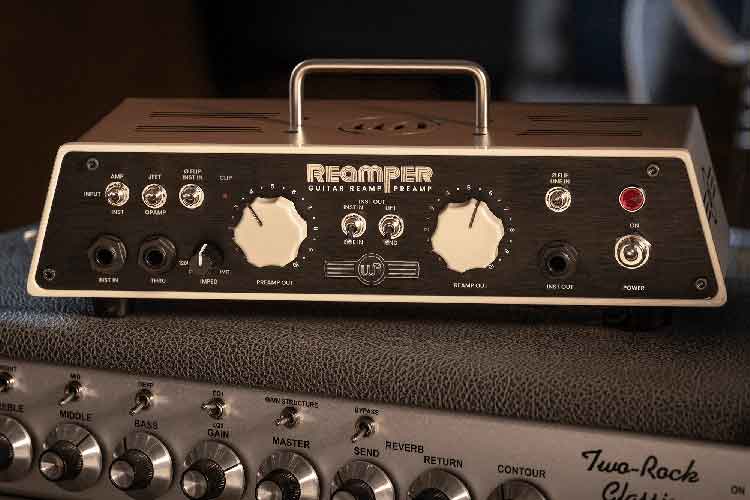
The Warm Audio Reamper is far more than a traditional re-amping box. It is a complete analog signal-routing hub designed to connect guitars, basses, keyboards, pedals, tube amplifiers, audio interfaces, DAWs, and professional studio processors without forcing you to rebuild your setup every time inspiration takes you in a different direction. Whether you are recording at home, working in a commercial studio, or experimenting with unconventional effects chains, the Reamper makes sophisticated routing remarkably fast and intuitive.
At the heart of the Reamper are two fully independent signal paths: an active instrument preamp and a dedicated re-amping section. This allows you to record a clean direct signal while simultaneously feeding your amplifier or pedalboard. You can commit to an inspiring amplifier sound while preserving a dry “safety” track that can be re-amped, processed through an amp simulator, or layered with another tone later. It provides the confidence and responsiveness of playing through a real amplifier without locking the recording into a single sound.
That ability alone makes the Reamper incredibly valuable. A great performance is often the hardest part of a session to recreate. With a clean version safely recorded, you can concentrate on the playing and make tone decisions afterward. The dry track can be sent back through a different amplifier, a second pedal chain, or an entirely different studio setup without asking the musician to replay the part. You can compare cabinets, microphones, amplifier settings, gain structures, and effects while working from the exact same performance.
Reamper takes this familiar recording technique much further than a conventional re-amp box. Its dual-channel architecture allows the instrument preamp and re-amping paths to operate independently, creating possibilities that would normally require several separate utility boxes and a more complicated patching arrangement. It can function as a high-quality instrument preamp, re-amping interface, impedance-matching device, transformer-isolated routing box, pedal integrator, amplifier splitter, and silent tube-amplifier recording solution.
The built-in 50-watt, 8-ohm power soak is one of its most exciting features. By connecting a compatible tube amplifier’s speaker output to the Reamper, you can capture the sound and response of both the preamp and power-amp sections without connecting a speaker cabinet. This allows you to push a tube amplifier into its ideal operating range while monitoring silently through your recording interface. Add an appropriate cabinet impulse response in your DAW and you have a practical way to record genuine cranked-amplifier tones at night, in an apartment, or in any studio where volume is a concern.
The silent-recording capability is especially useful because so much of a tube amplifier’s character comes from the power section. Lowering the master volume or relying only on a preamp output does not always produce the same compression, harmonic richness, dynamic response, and interaction that occurs when the power tubes are working. The Reamper’s internal load makes it possible to capture that character without subjecting your neighbors, family, clients, or studio staff to full speaker-cabinet volume. The amplifier must be rated at no more than 50 watts and matched to the Reamper’s 8-ohm load, but within those requirements, it is an exceptionally useful recording option.
Signal quality is clearly a priority throughout the design. The Reamper uses custom USA-made CineMag transformers to provide isolation across its signal paths. These premium transformers help preserve the musical character of the source while providing the electrical conversion and isolation needed when moving between instrument, line, and speaker levels. The result is a cleaner, more reliable connection between equipment that was never necessarily designed to work together directly.
The instrument preamp offers a choice between two distinct input stages. The discrete JFET setting provides a touch of analog color and character, while the JFET op-amp setting offers a cleaner and more transparent response. This makes the Reamper useful not only as a routing device but also as a creative front end. You can choose whether you want the instrument signal to remain extremely neutral or gain a little additional personality before it reaches the recorder or the rest of the signal chain.
Variable input impedance adds another valuable layer of tonal control. The instrument input can be adjusted continuously from 120 kΩ to 1 MΩ, allowing the Reamper to interact properly with a wide variety of pickups and instruments. Passive guitar pickups respond differently depending on the load they see, so changing the impedance can subtly reshape the instrument’s brightness, attack, resonance, and overall feel. Active instruments, basses, keyboards, synthesizers, and pedal outputs can also be accommodated without forcing every source through the same fixed input configuration.
The maximum instrument input level of +18 dBu, or 6 volts RMS, gives the Reamper substantial headroom. Hot active pickups, keyboards, pedals, and other higher-output sources can be handled without immediately overloading the input stage. Combined with the ultra-low-noise active circuitry, the unit delivers the headroom and clarity expected from professional studio equipment.
The re-amp output includes a stepless level control that can provide attenuation or gain. This makes it much easier to match the playback level from a DAW to the level that a guitar amplifier or pedal expects to receive. Proper level matching is essential when re-amping because an excessively hot signal can drive the amp very differently from the original instrument, while a signal that is too weak can sound flat or lifeless. The Reamper lets you adjust the level precisely instead of relying on fixed pads or broad preset ranges.
Balanced line-level inputs and outputs are provided on both XLR and quarter-inch connections, and the unit does not require phantom power. The XLR and TRS line outputs can also be used simultaneously, making it possible to send the preamp signal to multiple destinations. That opens the door to parallel recording, additional processing paths, or separate monitoring and capture chains without immediately needing another splitter.
The direct quarter-inch Thru output sends the unbuffered instrument signal to an amplifier or pedal chain, while the instrument output can deliver either the buffered instrument signal or a converted line-level source. This flexibility is what allows the Reamper to move so naturally between the guitar and studio worlds. The controls are clearly organized around real recording situations rather than abstract technical functions, so the signal flow remains manageable even when the routing becomes sophisticated.
Per-channel polarity inversion and ground-lift controls are extremely welcome in a device intended to connect multiple amplifiers and pieces of studio equipment. Combining a direct signal with an amplified or processed track can create polarity and phase relationships that weaken the sound instead of strengthening it. The phase-flip controls provide a quick way to correct obvious polarity problems, while the ground-lift function helps eliminate the hum caused by ground loops between connected systems.
The Reamper also turns ordinary guitar pedals into studio effects processors. A line-level recording from a DAW, mixer, or audio interface can be converted to the appropriate level and impedance for a pedal chain, processed through delays, reverbs, modulation effects, distortion boxes, filters, compressors, or ring modulators, and then returned to the balanced studio environment. Suddenly, a favorite pedalboard can process vocals, keyboards, drum loops, percussion, room microphones, and complete submixes—not just guitar.
The process works in the opposite direction as well. Professional rack-mounted compressors, equalizers, reverbs, delays, and other balanced line-level processors can be incorporated into an instrument chain. This creates an enormous range of hybrid analog possibilities. A guitarist can play through pedals, route the signal through studio compression or EQ, and then continue into an amplifier. A synthesizer can be combined with guitar effects and outboard processing. A dry track can pass through several stages of real analog equipment before returning to the DAW.
The Reamper can even help create multi-amplifier setups. Its routing options allow one performance to feed two amplifiers, making it possible to record contrasting tones simultaneously. One amplifier might provide clean definition while the other contributes distortion and sustain. A bright amplifier can be blended with a darker one, or two completely different cabinets and microphone combinations can be recorded from the same take. This is a much more efficient way to build a wide guitar sound than attempting to duplicate the performance perfectly.
Despite the number of applications it supports, the Reamper remains refreshingly hands-on. There are no menus, presets, software editors, converters, or digital processing stages. It is an entirely analog device with dedicated controls and clearly labeled connections. You can see the routing, adjust levels by ear, change the impedance, switch between the JFET and op-amp stages, correct polarity, lift the ground, and immediately hear the result.
The internal universal power supply accepts 100 to 240 volts AC at 50 or 60 Hz, so there is no external wall wart to lose and no separate regional power supply to replace when traveling. The professional construction, quality components, fully active low-noise circuitry, and five-year warranty all reinforce the sense that this is a serious piece of studio equipment built for long-term use.
At an MSRP of $499, the Warm Audio Reamper provides an impressive amount of capability for the price. Recreating the same functionality with separate direct boxes, re-amp boxes, transformer-isolation devices, impedance controls, splitters, line-to-instrument converters, and an amplifier load would cost considerably more and create a much more complicated studio setup. Consolidating all of those jobs into a single purpose-built device saves money, space, cabling, setup time, and frustration.
Most importantly, the Reamper encourages experimentation. It makes it easy to try a different amplifier after the musician has left, run a vocal through a guitar pedal, place a rack compressor in front of an amp, capture two amplifiers from one performance, or record a tube amp silently in the middle of the night. Instead of avoiding an idea because the routing is too complicated, you can connect it and hear the result.
The Warm Audio Reamper is an outstanding creative tool for guitarists, bassists, producers, recording engineers, and anyone who enjoys combining instruments, amplifiers, pedals, and studio equipment in new ways. Its independent preamp and re-amp paths, custom CineMag transformers, variable impedance, selectable JFET input stages, balanced XLR and quarter-inch connectivity, stepless re-amp level control, polarity and ground management, and built-in 50-watt/8-ohm power soak make it far more capable than a standard re-amping box.
This is the kind of equipment that can quietly become the center of a recording setup. It solves common studio problems, protects performances by capturing a clean backup, makes real tube amplifiers practical in volume-sensitive environments, and opens creative routing possibilities that previously required a rack full of specialized tools. The Warm Audio Reamper does not simply move signals from one place to another—it makes the entire studio feel more connected, flexible, and musical. Highly recommended.


