
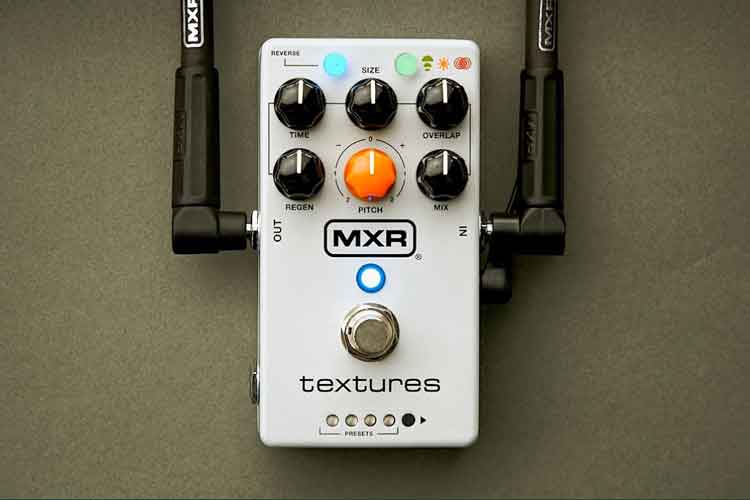
The MXR Textures Granular Synth Engine is one of the most imaginative, inspiring, and musically useful effects pedals I have encountered. Calling it a delay, reverb, synthesizer, or ambient pedal does not adequately describe what it can do. The M310 feels more like a complete sound-design instrument that happens to fit on a pedalboard. It can take a single note, chord, rhythmic figure, or sustained passage and reshape it into shimmering pads, fractured glitches, cascading pitch-shifted echoes, dreamlike reverberations, and slowly evolving atmospheric layers.
Granular synthesis can be an intimidating concept, but MXR has done an excellent job of making it accessible without sacrificing depth. Instead of simply repeating what you play like a conventional delay, the M310 records the incoming signal and breaks it into tiny pieces called grains. Those grains can then be resized, overlapped, reversed, pitch-shifted, randomized, regenerated, and rearranged in time. The result is an effect that reacts to your performance in ways that can be beautifully subtle, completely unpredictable, or anywhere in between.
What makes the Textures Granular Synth Engine so successful is that it never feels like technology for its own sake. Even when it is producing sounds that are unusual or otherworldly, the pedal remains connected to the musical character of the original performance. A chord can bloom into a wide, orchestral pad. A short melodic phrase can dissolve into a cloud of harmonics. A heavy riff can be surrounded by a shifting layer of mechanical glitches and reversed fragments. A single sustained note can become an evolving background that sounds like an invisible synthesizer player accompanying you.
The three operating modes give the M310 an extraordinary amount of range. Delay Mode is the easiest entry point because it behaves somewhat like a familiar delay pedal, continuously recording what you play and returning it as manipulated grains. Depending on the settings, those grains can sound like clean rhythmic repeats, smeared ambient trails, reversed echoes, pitch-shifting cascades, or sputtering fragments. It can support a performance quietly in the background or become the central feature of the sound.
Auto-Freeze Mode is especially impressive. The pedal listens to what you play, captures a note or chord, and sustains it as an evolving wash of granular sound. Instead of producing a motionless frozen chord, the M310 keeps processing the captured audio so that it breathes, shifts, and changes over time. This is perfect for creating pads beneath melodies, extending the harmony between sections, or filling space without relying on a separate keyboard or backing track. It can make one musician sound as though an entire atmospheric arrangement is unfolding behind the performance.
Layers Mode takes that idea even further by capturing as many as four notes or chords in separate buffers. Each layer has its own fade-in and fade-out behavior, making it possible to stack harmonies, construct polyphonic pads, and build miniature orchestral arrangements in real time. When a fifth layer is introduced, it replaces the oldest one, allowing the soundscape to keep developing as the music changes. This mode alone could inspire complete compositions, introductions, transitions, and cinematic interludes.
The primary controls are thoughtfully arranged and surprisingly intuitive. Size determines the length of each grain, moving the sound from tiny digital fragments to longer, more recognizable musical passages. Overlap controls how many grains can play simultaneously, allowing the effect to move from sparse and rhythmic to dense, smooth, and cloudlike. Pitch can shift the grains from two octaves below to two octaves above the original signal, while Reverse changes the direction in which they are played. Time, Regen, and Mix provide detailed control over how the grains move, repeat, develop, and interact with the dry instrument signal.
The secondary parameters reveal just how deep the M310 really is. Holding the Reverse or Mode button while adjusting the controls opens another layer of sound-shaping possibilities. Grain size, timing, overlap, pitch, and reverse behavior can all be randomized, creating textures that continually change and rarely repeat in exactly the same way. The built-in reverb, dual low-pass and high-pass filter, vibrato, pitch quantization, and feedback routing provide even more ways to sculpt the final result. These features allow the pedal to move effortlessly from warm and organic ambience to unstable tape-like movement, synthetic harmonies, rhythmic glitches, and complete sonic chaos.
The eight onboard presets are a very smart addition. They provide immediate access to some of the M310’s most impressive sounds and make the pedal approachable from the moment it is connected. A player can select a preset and begin making music without first understanding every aspect of granular synthesis. Once a preset provides a useful starting point, the controls invite further exploration. It is easy to make small adjustments, discover an unexpected sound, and then save the result as something completely personal.
MXR also included the connectivity needed to make the M310 useful in a professional setup. It supports stereo input and output, wet/dry routing, external tap tempo, preset scrolling, freezing, and expression-pedal control. The expression capabilities are particularly exciting because they allow multiple parameter settings to be assigned to the heel and toe positions. Instead of simply turning one effect level up and down, an expression pedal can morph between two dramatically different granular environments during a performance.
The M310 works beautifully for ambient music, abstract soundscapes, progressive rock, experimental metal, shoegaze, electronic music, film scoring, and studio sound design. It can create a subtle bed beneath a clean guitar passage, add dreamlike movement behind a solo, or introduce strange electronic textures under an aggressive riff. It is equally capable of producing something beautiful, unsettling, rhythmic, spacious, chaotic, or cinematic.
Most importantly, the MXR Textures Granular Synth Engine is fun. It rewards curiosity and encourages a different approach to playing and composition. Small control changes can produce entirely new sounds, and the pedal frequently creates moments that would be difficult to imagine in advance. It does not simply decorate what you play; it can become an active creative partner that suggests new melodies, arrangements, and musical directions.
The MXR Textures M310 is an outstanding achievement. It combines the adventurous possibilities of granular synthesis with the durability, practicality, and musician-friendly design expected from MXR. Beginners can find inspiring sounds immediately through the presets, while experienced sound designers can spend countless hours exploring its deeper functions. This is much more than another effect pedal. It is a self-contained universe of sound, and it may be one of the most exciting and creatively rewarding pedals MXR has ever produced.


